Why Social Data Matters in Search
Search is no longer a passive interface for retrieving information. It has become a foundational layer for how AI systems, agents, and applications interpret the world and act within it.
At OptimAI Search, we design search infrastructure for environments where information is fluid, narratives evolve rapidly, and decisions cannot rely on static representations of reality. This perspective has guided the architecture of OptimAI Search, which is now live as a decentralized search engine built for real-time, context-aware intelligence.
The Problem With Web-Only Intelligence
Most AI search systems are built primarily on the public web: articles, blogs, documentation, and indexed pages. While this data remains valuable, it reflects a delayed view of reality.
The web captures outcomes, not formation. It records conclusions after discussion, disagreement, and interpretation have already occurred. By the time information is published and indexed, the underlying narrative has often shifted.
This creates a structural limitation. Web-only search answers what is already settled, while many real-world decisions depend on understanding what is still unfolding.
Where Meaning Is Formed Today
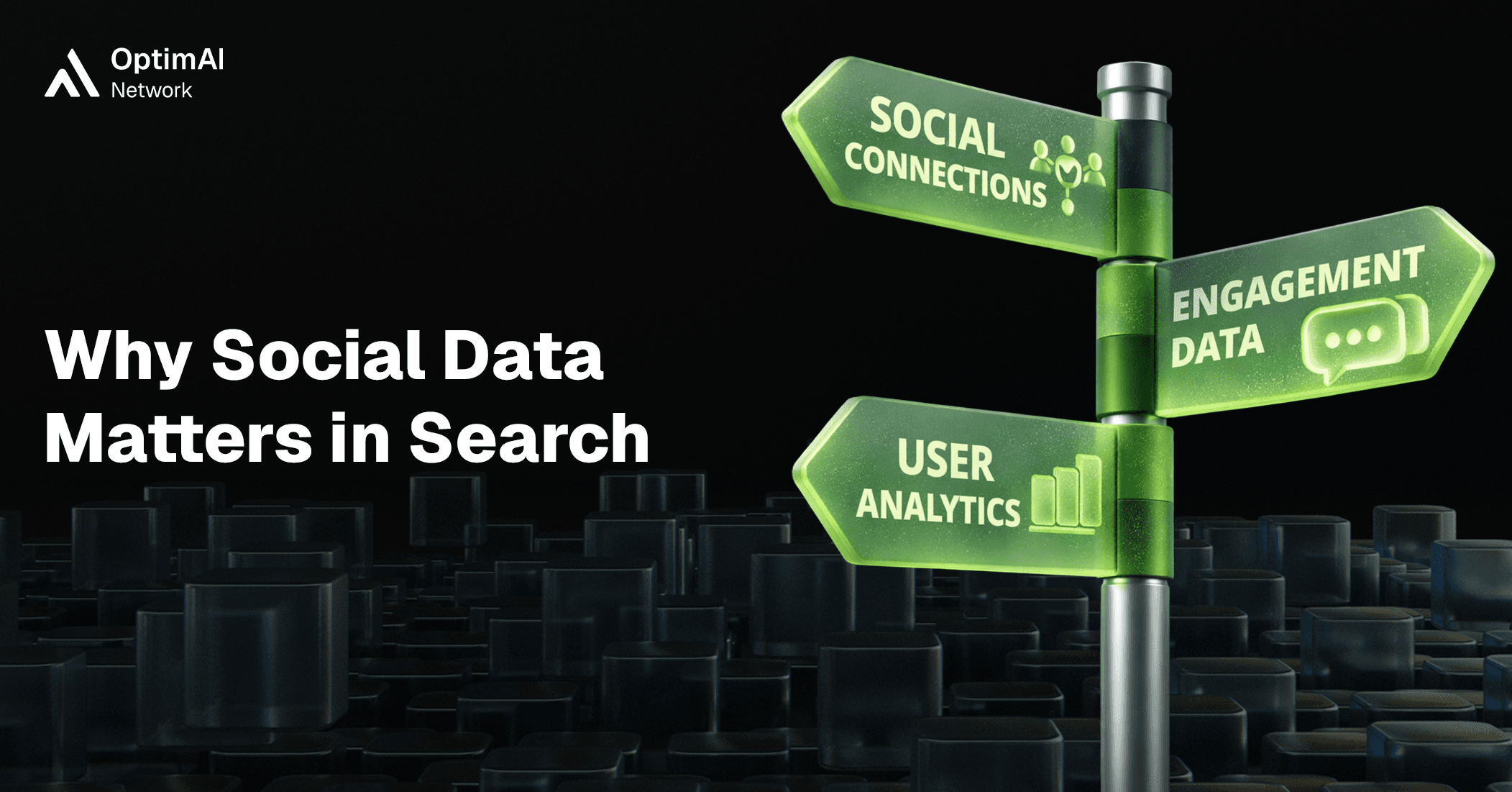
Modern narratives emerge in real time across social platforms. On X, early signals, expert reactions, and counter-arguments surface within minutes. LinkedIn shapes how these signals are interpreted through institutional, economic, and strategic lenses. Telegram hosts high-density community discussions, often closest to source-level developments.
Together, these platforms form a live interpretive layer where meaning is negotiated before it becomes formalized web content. Search systems that ignore this layer operate without visibility into how relevance, trust, and consensus are actually formed.
Why Real-Time Sentiment Changes Answers
Search is often treated as a static exercise: retrieve facts, summarize them, return an answer. In practice, relevance is time-dependent.
The same question can require a different response as:
- Sentiment shifts from uncertainty to validation
- New evidence or voices enter the conversation
- Risk perception or urgency changes
Social data exposes these shifts. It provides insight into how information is being received and interpreted in the present moment, not just how it was documented in the past.
For AI systems and agentic workflows, this distinction is critical. Decisions based on outdated context can be more misleading than decisions made with partial but current information.
Social Data as Core Search Infrastructure
At OptimAI Search, social data is treated as infrastructure and not enrichment. OptimAI Search operates as a decentralized system where independent nodes retrieve and preprocess information from across the open web and social platforms in parallel. Context is not imposed by a centralized ranking mechanism. It emerges through aggregation, provenance, and synthesis across multiple sources.
This architecture allows OptimAI Search to:
- Capture early signals before narratives stabilize
- Surface multiple perspectives rather than collapsing them into a single viewpoint
- Produce answers that are both verifiable and situationally aware
Social data does not replace factual grounding. It situates facts within the moment they are being interpreted.
Designing Search for Agentic Systems
As AI systems become increasingly agentic, executing tasks, coordinating actions, and making decisions autonomously it compromises because the cost of missing context increases. Search infrastructure must evolve accordingly. It must move beyond static indexes toward systems that understand how meaning forms and shifts in real time.
OptimAI Search is built for this because we integrate social data as a first-class input and distributing retrieval across an open network. This enables context-aware search that reflects not only what is known, but how understanding is actively evolving.
Explore the search engine here:
👉 https://optimai.network/search-engine
About OptimAI Network
OptimAI is a decentralized AI network designed to enable real-time, continuously learning agentic AI systems powered by community-owned data and distributed compute. Built on a DePIN architecture with an EVM-compatible Layer-2 backbone on OP-Stack, OptimAI solves a core limitation of centralized AI platforms: reliance on static, low-context, and often proprietary data.
Through privacy-first data mining, community-driven validation (via DeHIN), and edge-based inference, OptimAI creates a reinforcement data layer that fuels adaptive, user-owned agents. The flagship OptimAI AI Agent delivers autonomous research, search, and content workflows across web and social platforms: agents that evolve over time through decentralized reinforcement rather than one-off prompts.
Launched in March 2025, OptimAI has scaled rapidly to over 970,000 deployed nodes and 50,000+ active agentic users, backed by YZi Labs (EASY Residency S1) and CoinMarketCap’s CMC Labs. OptimAI Persona Agentic System stands as a Web3-native alternative to centralized solutions like Manus AI, ChatGPT Operator, and Grok. The project earned external validation when CZ recognized it as the leading persona-based agentic solution during the Personalized AI Challenge on Binance Square in August 2025.
Links
Website: https://optimai.network
Node Dashboard: https://node.optimai.network
Documentation: https://docs.optimai.network
X (Twitter): @OptimaiNetwork
Telegram: t.me/OptimaiNetwork