Understanding Edge Compute in the Context of OptimAI DePIN
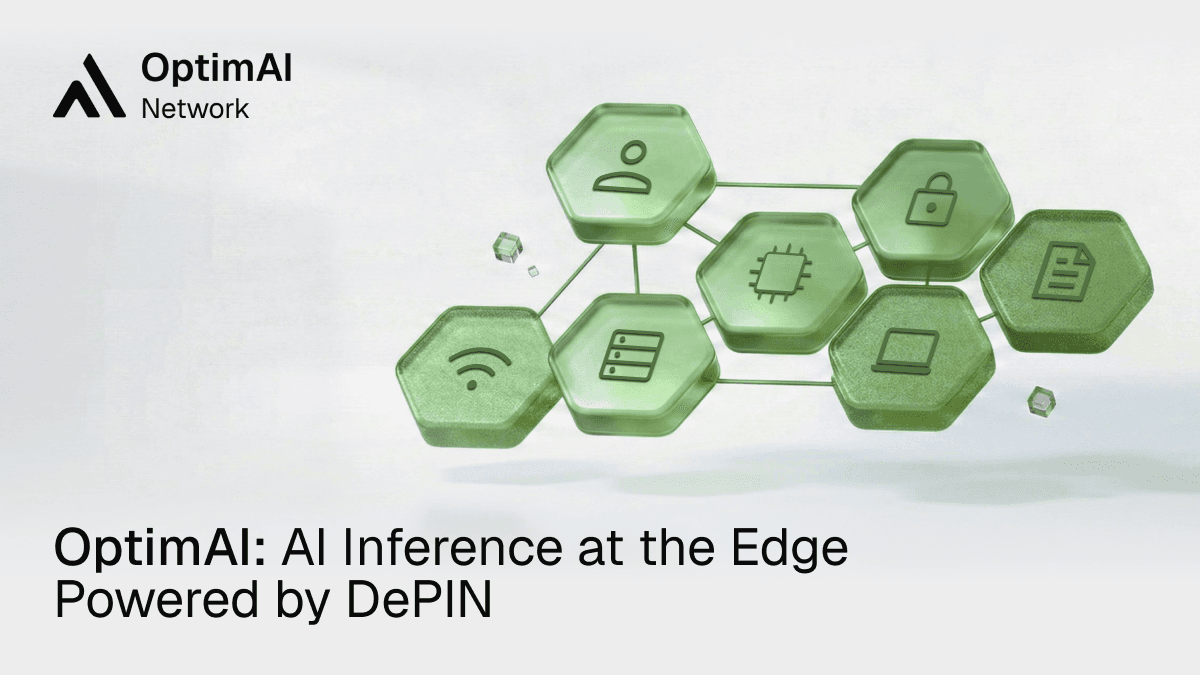
Edge computing processes data closer to its source on end-user devices at the network's edge rather than sending everything to centralized data centers. This reduces latency, boosts responsiveness, enhances bandwidth efficiency, and supports real-time applications.
In DePIN edge computing gains massive scale by crowdsourcing idle resources from global participants. Everyday devices like smartphones, laptops, and browsers become active contributors, forming a resilient, distributed infrastructure without heavy reliance on institutional data centers.
OptimAI Network embodies this fully as an L2 DePIN Reinforcement Data Network for agentic AI. It transforms user devices into nodes that provide bandwidth, compute power, edge caching, and data contributions. Participants earn rewards via points convertible to $OPI for mining data, validating, and powering AI tasks, creating organic, community-driven scaling.
Unlike traditional AI setups where heavy inference runs on centralized GPU clusters in hyperscale clouds, OptimAI pushes edge-native execution for low-latency, privacy-focused operations. Inference and lightweight AI tasks happen directly on devices via Edge Nodes (mobile) and Lite Nodes (browser/Telegram), while heavier workloads leverage Core Nodes (desktop/server). This supports autonomous agentic AI, reinforcement learning, data scraping/validation, and real-time processing with minimal centralized bottlenecks.
Training may involve some centralized coordination for efficiency, but inference, edge compute, and reinforcement run distributed, balancing performance, cost, and decentralization through the OptimAI Compute Engine.
OptimAI’s Architecture for Device-Based Inference
OptimAI's node system is tiered for broad accessibility and performance:
- Lite Nodes The easiest entry: run via browser extensions (Chrome), Telegram mini-apps, or web interfaces with no extra hardware needed. They focus on lightweight tasks like data mining/scraping, validation, basic edge compute, and contributing to the reinforcement data layer. Ideal for quick participation and earning rewards with zero setup friction.
- Edge Nodes Mobile-first for smartphones (available on Android via Google Play and iOS via App Store). These run in the background, handling more intensive operations like localized AI inference, data processing, and edge computing while optimizing for battery life and data usage. They bring true on-device AI power to users on the go.
- Core Nodes For desktops/servers (Windows, macOS, Ubuntu; also CLI variants). These deliver heavy-lifting: full CPU/GPU compute for AI training/inference at the edge, data indexing, embeddings, edge caching, bandwidth sharing, and advanced network tasks. Perfect for power users, developers, or those with stronger hardware.
These nodes feed into the OptimAI Compute Engine, a decentralized system aggregating community resources for scalable AI training, deployment, inference, and agent operations. Key integrations include:
- Edge computing for local, low-latency AI decisions
- Federated-style mechanisms for collaborative model improvement without raw data sharing
- Decentralized storage and dynamic bandwidth sharing
- DeHIN (Decentralized Human Intelligence Network) for crowdsourced validation/annotation
This enables agentic AI to run autonomously on user devices, researching, generating, refining, and acting with reduced server dependency.
Key Optimizations for Low-Latency Inference
Resource-constrained devices (phones, browsers) demand smart optimizations. OptimAI aligns with edge-AI best practices to enable efficient, on-device inference:
- Model Optimization
- Quantization: Lowers precision to shrink model size and speed up compute while preserving accuracy, critical for mobile CPUs/GPUs.
- Pruning and Knowledge Distillation: Removes redundant weights; distills knowledge from large models to compact versions for faster edge execution.
- Low-Rank Factorization: Approximates weights with lower-dimensional structures, reducing memory and FLOPs for browser/WebAssembly environments.
- Data Optimization
- Compression and Filtering: Minimizes bandwidth/processing for incoming data.
- Edge Caching: Stores frequent data/models locally for instant reuse.
- Privacy-Preserving Collaboration: Edge nodes process locally; aggregated insights feed the network without exposing raw user data.
- System and Hardware Optimization
- Hardware Acceleration: Leverages built-in AI chips, WebGPU/WebAssembly in browsers for GPU-like speed.
- Dynamic Allocation: L2 blockchain routes tasks to optimal nearby/edge nodes.
- Background/Idle Processing: Nodes use spare cycles without disrupting device use, battery-efficient on mobiles.
Benefits and Practical Implications
- Ultra-Low Latency: Enables real-time agentic apps like autonomous content creation and social automation.
- Privacy and Security: Data stays on-device or validated decentrally, reduced breach risk.
- Organic Scalability: Grows with users; no central capex.
- Cost Efficiency: Leverages idle hardware, cheaper than hyperscale clouds.
- Inclusivity: Anyone with a phone/browser joins, democratizing AI contribution/ownership.
Challenges like device heterogeneity are addressed via incentives, adaptive tasks, and continuous reinforcement.
The Future of Edge-Driven AI
As agentic AI embeds everywhere, centralized clouds hit limits in cost, latency, and control. OptimAI shows DePIN plus edge compute can build scalable, resilient, user-owned intelligence running inference on phones, browsers, and laptops worldwide.
This empowers developers to create faster, private, distributed agents. Run a node at https://optimai.network, contribute to reinforcement data, and help shape autonomous AI. The network is not just infrastructure, it is collective intelligence in action. 🚀
About OptimAI Network
OptimAI is a decentralized AI network designed to enable real-time, continuously learning agentic AI systems powered by community-owned data and distributed compute. Built on a DePIN architecture with an EVM-compatible Layer-2 backbone on OP-Stack, OptimAI solves a core limitation of centralized AI platforms: reliance on static, low-context, and often proprietary data.
Through privacy-first data mining, community-driven validation (via DeHIN), and edge-based inference, OptimAI creates a reinforcement data layer that fuels adaptive, user-owned agents. The flagship OptimAI AI Agent delivers autonomous research, search, and content workflows across web and social platforms: agents that evolve over time through decentralized reinforcement rather than one-off prompts.
Launched in March 2025, OptimAI has scaled rapidly to over 1,500,000 deployed nodes, 800,000+ registered node users, and 50,000+ active agentic users, backed by YZi Labs (EASY Residency S1) and CoinMarketCap’s CMC Labs. OptimAI Persona Agentic System stands as a Web3-native alternative to centralized solutions like Manus AI, ChatGPT Operator, and Grok.
Links
Website: https://optimai.network
Node Dashboard: https://node.optimai.network
Documentation: https://docs.optimai.network
X (Twitter): @OptimaiNetwork
Telegram: t.me/OptimaiNetwork