The Nervous System of the Autonomous Age
The old internet was built for humans browsing pages, clicking ads, and buying subscriptions. The autonomous internet needs something else: live context, verified signals, permissioned execution, and a feedback loop that makes systems better over time. In other words, it needs a nervous system.
That is the layer OptimAI is building.
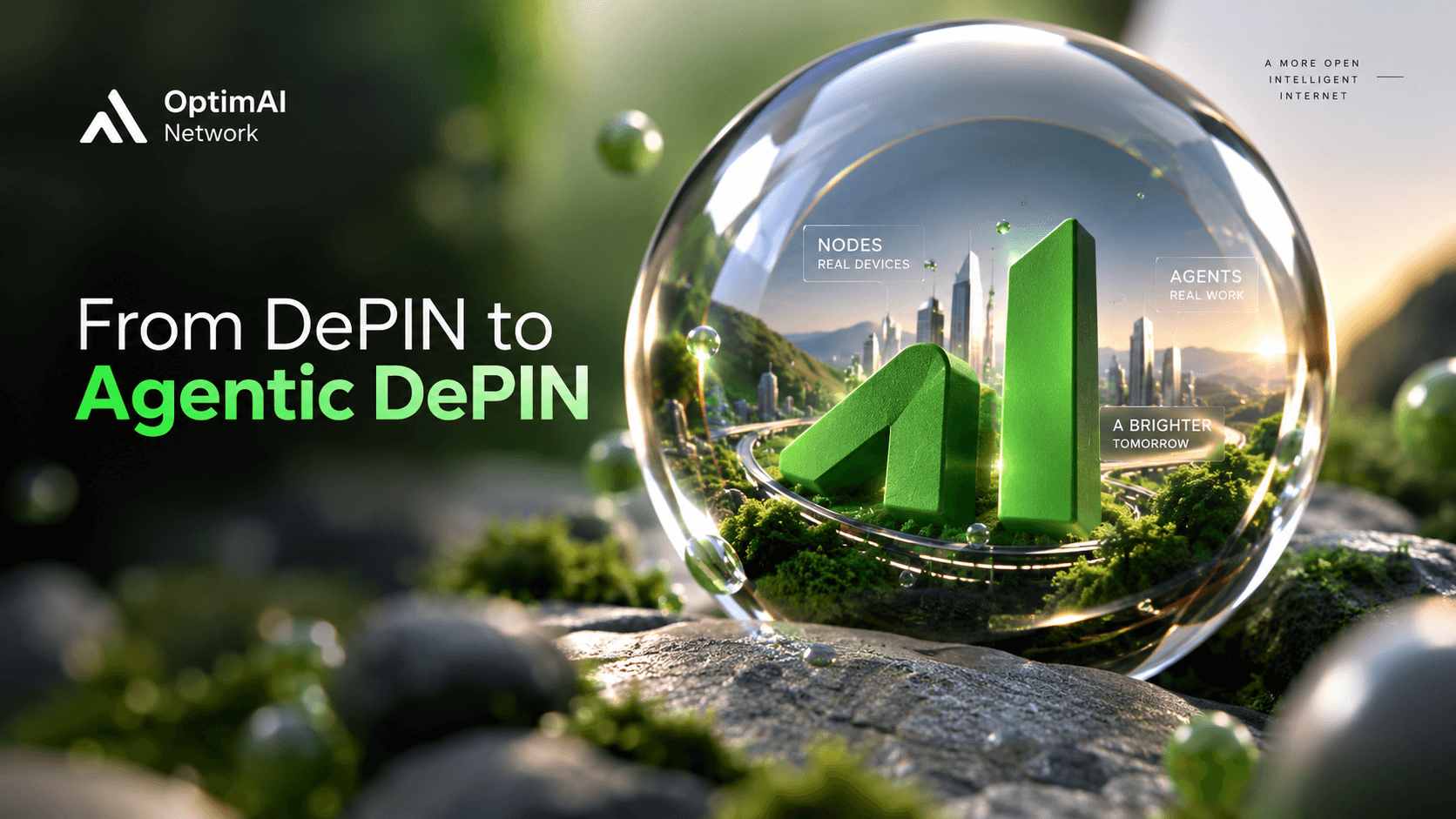
OptimAI is building the agent-native internet: a decentralized real-time intelligence network powered by community nodes that crawl, process, validate, and aggregate data across hundreds to thousands of sources. Unlike static indexes, OptimAI keeps the data live and continuously updated so autonomous systems can work from current, machine-usable intelligence rather than stale snapshots.
This matters because the bottleneck in agentic AI is no longer simply model quality.
It is grounding.
A model can reason well and still fail if the signals it sees are stale, incomplete, or impossible to trust. An autonomous system needs live web and social context, on-chain signals when relevant, and a way to verify what it is seeing before it acts. That is why the next phase of AI is not just “smarter models.” It is better infrastructure for intelligence that has to operate in the real world.
OptimAI’s stack is designed around that reality.
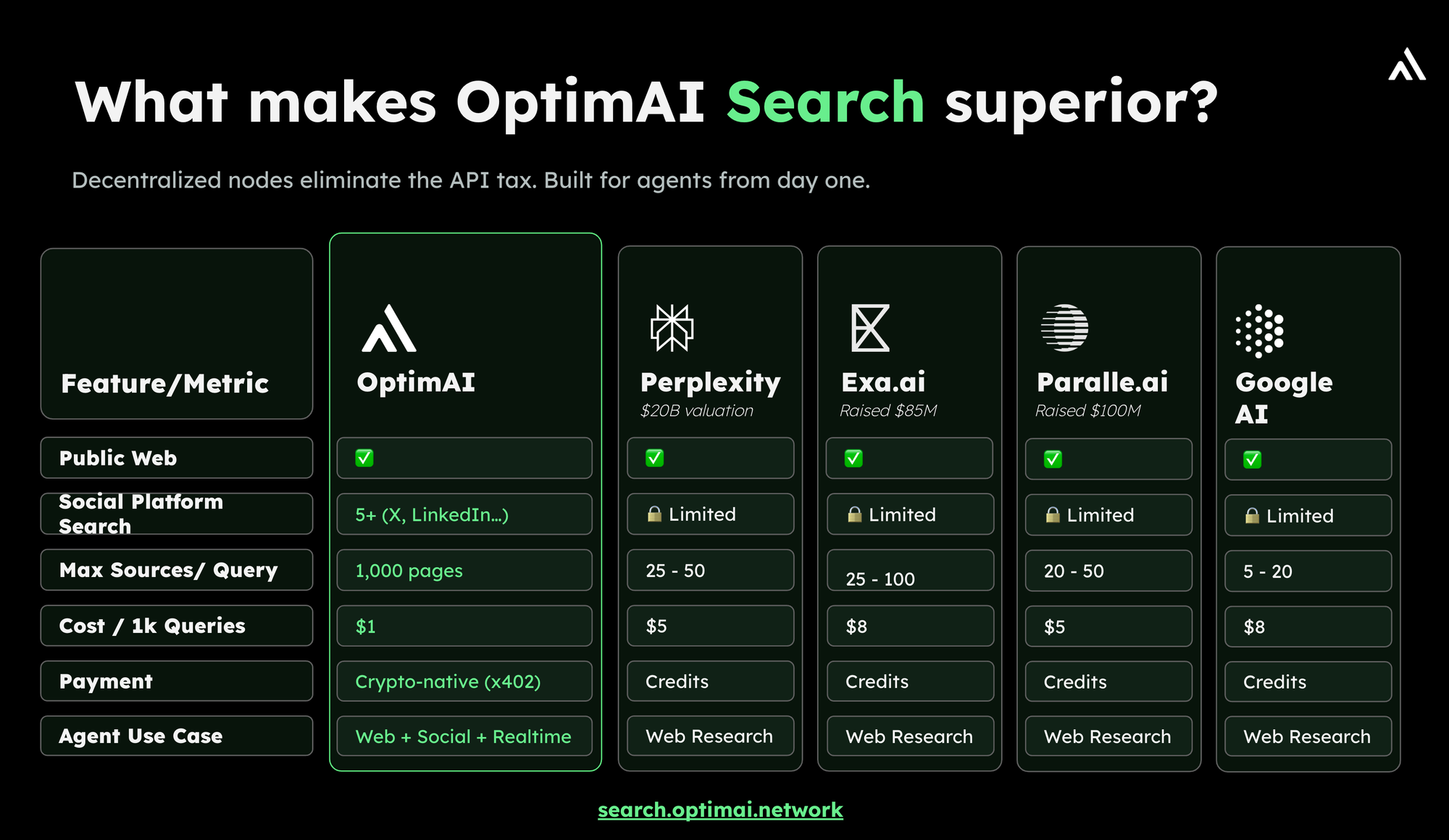
OptimAI Search turns the open web, social web, and onchain data into live intelligence agents can actually use. It is not a search product in the traditional sense. It is a context layer for autonomous systems.
OptimAI Persona Agent gives that intelligence a persistent runtime: memory, voice, preferences, and domain-specific knowledge that can follow the user across tasks instead of resetting every session.
OptimAI Claw turns that context into action directly on the device. And the broader OptimAI node network - browser, desktop, mobile, and CLI - keeps the system distributed, scalable, and community-powered.
That combination is important because autonomous systems do not fail in abstract ways. They fail at the handoff.
They can summarize but not finish.
They can suggest but not execute.
They can browse but not retain context.
They can reason but not reliably pay, verify, or continue.
OptimAI is built to close those gaps. It is clear that a research agent should be able to search across the web and social feeds, preserve user context, pay for premium data when needed, and return a usable report; a trading agent should be able to combine on-chain metrics, social signals, and risk rules; a travel or procurement agent should be able to complete the flow across services with native payment and user consent.
The larger market is already moving in this direction.
Google is pushing agentic search and long-horizon tasks. Microsoft has been framing agents as the new apps. Base is describing agents as the internet’s newest paying customers. Cloudflare and Coinbase have helped push x402 into the conversation, making request-level payments part of the agent stack. The direction is converging: agents need live context, native payments, scoped permissions, and systems that are built for machine consumption from the start.
That is where OptimAI stands out.

Most teams are building either better models or standalone agents. OptimAI is building the infrastructure underneath them: a live intelligence layer that makes agentic workflows useful, trustworthy, and scalable. The company’s architecture creates a compounding loop: more nodes improve coverage, more coverage improves freshness, more freshness improves agent quality, and better agents drive more usage back into the network. That is not just a product dynamic. It is a network effect.
This is also why decentralization matters.
A centralized system can be fast, but it tends to be brittle, expensive, and closed. A decentralized system can be resilient, more scalable, and more aligned with the people contributing to it. OptimAI’s view is that the intelligence layer should not be controlled by a single gatekeeper. It should be built by the network that uses it.
The most interesting shift in the AI market is not that agents are getting better at chatting.
It is that they are becoming better at operating.
That means the real winners will not be the companies with the loudest demos. They will be the companies that build the live intelligence backbone beneath the demos - the systems that let agents search, verify, execute, and improve continuously.
OptimAI is building for that world.
Not another chatbot.
Not another wrapper.
A decentralized intelligence network for autonomous systems that need to understand reality as it changes.
The future is autonomous.
The question is not whether agents will need a nervous system.
The question is who gets to build it.
OptimAI is building it for the people, by the people.