Assistants vs. Agentic AI
What Actually Makes the Difference: With Real-World Context from OptimAI Network
Artificial intelligence is rapidly transitioning from reactive chat interfaces to autonomous digital systems capable of independent reasoning and execution. While both prompt-based assistants and agentic AI systems leverage large language models, the functional gap between them is substantial.This distinction becomes particularly clear when examining agentic systems powered by decentralized, reinforcement-driven infrastructure such as the OptimAI Network.This analysis compares the two paradigms across four critical dimensions: autonomy, personalization, data access, and execution context, grounding the discussion in real-world architecture and network scale as of February 2026.
1. Autonomy
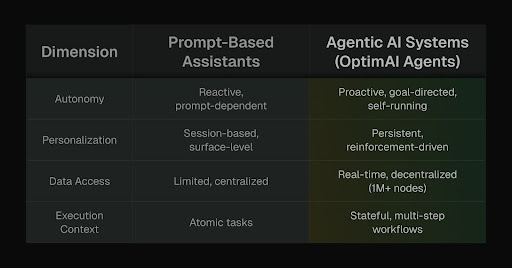
Prompt-Based AI AssistantsTraditional AI assistants are reactive by design. They respond to user inputs in single-turn or short-thread interactions and require continuous prompting for multi-step tasks. Planning, state management, and execution sequencing remain user-driven.These systems excel at generating responses but do not independently pursue goals.Agentic AI SystemsAgentic AI systems operate with high autonomy. When given a high-level objective, they:
- Decompose tasks into logical steps
- Evaluate alternative strategies
- Adapt to new information
- Execute across tools and environments
- Iterate through reinforcement feedback loops
OptimAI Agents exemplify this model. Once provided with a goal, for example, “plan weekly meals” or “grade essays fairly," the agent autonomously sources relevant data, validates insights, executes workflows, and continuously refines performance without repeated prompting.The shift is from AI that waits for instructions to AI that acts with structured independence.
2. Personalization
Prompt-Based AI AssistantsPersonalization is largely session-bound. Context is limited to recent interactions unless manually preserved. Long-term behavioral adaptation is minimal and requires external memory frameworks or re-prompting.Agentic AI SystemsAgentic systems develop persistent user profiles. They learn from outcomes, incorporate reinforcement signals, and evolve behavior over time.Within the OptimAI ecosystem, agents continuously improve through user feedback and community-validated reinforcement data. The result is a system that becomes progressively aligned with individual preferences, domain requirements, and usage patterns, without requiring repeated configuration.Personalization shifts from surface-level adaptation to longitudinal learning.
3. Data Access
Prompt-Based AI AssistantsConventional assistants rely primarily on pre-trained knowledge, limited tool integrations, and user-provided inputs. Access to real-time, diverse, or authenticated data environments is typically constrained.Agentic AI SystemsAgentic AI thrives on dynamic data ecosystems. OptimAI Agents draw from a decentralized reinforcement data network powered by over 1 million registered nodes as of February 2026. These nodes span 179+ countries and include browser extensions, mobile edge nodes, and desktop core nodes.This distributed infrastructure enables:
- Real-time global data sourcing
- Community validation and annotation
- Reinforcement learning with human feedback
- Privacy-preserving federated learning
The outcome is broader data diversity, fresher insights, and reduced dependency on centralized data silos.
4. Execution Context
Prompt-Based AI AssistantsExecution is typically atomic: single tasks, isolated outputs, and limited state tracking. Multi-step processes require manual orchestration by the user.Agentic AI SystemsAgentic AI maintains persistent execution contexts. These systems:
- Track long-horizon workflows
- Manage state across sessions
- Handle contingencies and failures
- Coordinate across tools and environments
OptimAI’s two-layer architecture enables this capability:Infrastructure Layer (Operational Backbone)
- Edge compute for low-latency processing
- Federated learning for privacy
- Decentralized storage for resilience
- Distributed bandwidth across 1M+ nodes
Reinforcement Data Layer (Adaptive Intelligence Core)
- Data mining and aggregation
- Annotation and structuring
- Community validation
- RLHF-driven behavioral alignment
Together, these layers create a continuous improvement loop:

Provide a caption (optional)This architecture transforms AI from reactive software into evolving digital operators.
Network Scale & Growth (February 2026)
The credibility of agentic AI depends on infrastructure maturity. OptimAI Network has demonstrated significant scale:
- 1M+ registered nodes globally
- Nodes active across 179+ countries
- Hundreds of thousands of earlier installations and users reported in late 2025
- Millions of reinforcement data contributions processed monthly
This scale indicates operational reinforcement, not theoretical capacity. Nodes actively mine, validate, and structure data, supporting real-time agent performance.
Summary Comparison
Why the Shift Matters
Prompt-based AI assistants remain valuable for rapid responses and creative generation. However, they encounter structural limits when complexity, real-time adaptation, and independence are required.Agentic AI systems represent a structural evolution. By combining decentralized data reinforcement, distributed compute, and prompt-based agent creation, networks such as OptimAI are lowering barriers to autonomous AI deployment.This transition reframes AI from tool to collaborator.In practical terms, this enables:
- Students deploying structured study agents
- Educators automating fair assessment workflows
- Creators launching digital twins aligned with their voice
- Professionals delegating research, monitoring, and execution tasks
The distinction is no longer incremental. It is architectural.
Conclusion
The evolution from assistant to agent marks a defining inflection point in artificial intelligence. Backed by over one million nodes and a rapidly scaling global infrastructure, the OptimAI Network positions agentic AI as transparent, adaptive, and community-driven.The difference between reactive AI and autonomous systems is not merely technical. It represents the transition from AI as interface to AI as infrastructure.In 2026, that distinction defines the next phase of intelligent systems.